Tuesday, 19 November 2013

Angiosperms and Gymnosperms

2013 marks Darwin's 200th birthday and 150 years of "The Origin of Species" ...

Darwin's Abominable Mystery: the Abundant and Amazingly Successful Angiosperm that so graces our planet in its myriad expressions of beauty....

Lemon Flowers
Spring  flowers in my Northern California garden before the dry Mediterranean summer takes over.
Nasturtiums

 
From the mid-Cretaceous onward, the flourishing and amazingly diverse angiosperm family become the dominant floral family on planet earth (see graph below).

Angiosperms, flowering plants presented a bit of a conundrum to Charles Darwin and generations of biologists after him.  How did angiosperms radiate and diversify with such dizzying and effortless array into the myriad 300,000 forms that may be found within the covers of any Botanical Encyclopedia and which are sprinkled throughout parks and gardens of the world?  A trip to any art gallery in the world will confirm not only the impact of flowers on culture but  to our sense of wellbeing and romance as well.  Even a little white daisy poking its head through a crack in a wall brings with it a certain ineffable beauty.

The angiosperms are pollinated plants producing flowers and fruit that diverged from gymnosperms.  Although angiosperm-like fossil pollen has been found that dates to the Middle Triassic in Germany Hochhuli, P.A. and Feist-Burkhardt, S. (2013) , the first small flowering plants became widespread within 120 MYA, replacing conifers (gymnosperms) as the dominant tree type around 60-100 MYA.  Davies, T. J. et al. (2004)

As in the graph  below, 125 MYA gymnosperms which include cycads and conifers were the major plant groups.  Angiosperms were rather small plants, growing alongside stream or even dry salty places where their thick leaves helped conserve water.  Then between 125 to 65 MYA, flowering plants exploded from a small minority into 80% of all plants.  According to a theory of Berendse and Scheffer (2009), the reason has to do with soil quality.  Although Gymnosperms flourished in poor soils, they did not improve soil quality.  Angiosperm litter replenished soils however, creating a positive feedback between improved soil fertility and angiosperm expansion. 


From Cox and Moore, Biogeography (2010)

So returning to the question of refugia, how does the topic of angiosperms relate?  Well, indirectly there are some interesting contrasts to highlight.  Note the map below showing the richness of tree species on a Latitudinal Diversity Gradient (LDG).
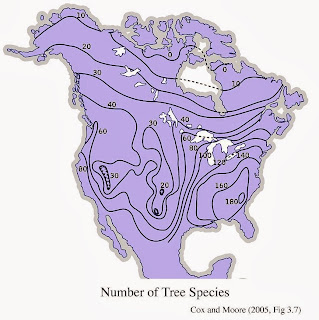
 

From Cox and Moore Biogeography (2010)
 
There are 644 tree species in Yasuni National Park, Ecuador - 
There are none at the North Pole.
There is a consistent latitidinal decline in life forms moving north
 
 
Simliar trends may be seen in mammals and birds.   Much greater diversity may be found closer to the equator.  It appears that the sun, warmth and moisture are kind to life on earth and that the cold, dry climes of far Northern Hemisphere are limiting factors for survival.  Note however that a correlation betwen latitude and evolution has not been fully resolved. Mittelbach, G.G. et al. (2007)
However, the following map which showing global diversity suggests a limiting trend of the Northern Hemisphere Pleistocene glaciation cycles.


Barthlott, Klier, Rafigpoor, Kreft, Kuper, Mutke & Nees Institut for Plant Biodiversity (2004)
 CLICK ON MAP TO ENLARGE
 
Finally, gymnosperms - the conifers -  largely outcompeted by the dazzling success of angiosperms adapted to harsher climates with needle-like leaves and structural cone shapes that did not facilitate much snow accumulation. 
 
Flowers are found at alpine locations but they tend usually to be small, hardy plants, such as Rosebay Willowherb (Epilobium Angustifolium) below.


This hardy little flower is one of the first to appear after a glacier retreats, such as this image from Glacier Bay in Alaska.
 
In a warming more humid world, perhaps this post might offer a ray of hope.......


Wednesday, 13 November 2013

Climate Change and Plants, historic and future uncertainties.....

Historically, plant species have adapted to climate change by moving to seek ways to survive within their optimal environmental envelope.  Pollen records from sediment cores have become important biological proxies of the rapid climate shifts during Pleistocene glacials, interglacials and stadials, supporting ice core and deep ocean proxy records. 

The Carp Lake, Washington, U.S. pollen record below dates 130,000 years and is of high resolution. 

CARP LAKE POLLEN RECORD - note absence of oak during LGM

Whitlock, C. and Bartlein, P. J. (1997)
 
During Last Glacial Maximum 18,000-20,000 years ago at Carp Lake, there was an increase of evergreens with an expansion of spruce in the late glacial but hemlock and cedar did not increase though there was an increase of sagebrush (Artemisia).This was a sagebrush/steppe environment, relatively cool and dry, not significantly wetter than the present.  There was a big shift at 80,000 years ago, a warmer isotope 5 period when oak came in. 

Current research suggests that in our rapidly warming 21st century, plants may be forced to move in excess of 1 km per year to keep up with the changing climate, according to Corlett and Westcott (2013)  In this article , the authors state that many plants will not be able to move fast enough to adapt with consequences for biodiversity and carbon storage.

Although ongoing research over the past 40 years is slowly elucidating historical patterns of past vegetation, there is still ongoing debate of many details of glacial refugia.  In order to have any pollen record, a sediment core from an anoxic sedimentary lake is required, lakes which in many arid parts have dried up.  Additionally, during the LGM,  many areas were cool and dry with minimal rain and low CO2 levels.  P. C. Tzedakis, B. C. Emerson and G. M. Hewitt (2013)believe there was an absence of temperate trees north of 45 degrees N and a west-east asymmetry in boreal tree distribution with a treeless Western Europe north of 46 degrees N, while restricted boreal populations persisted in Eastern Europe to 49 degrees N and higher latitudes east of the Fennoscandian ice-sheet. 
 
In future decades, vegetation will no doubt struggle to adapt to climate change within a certain climatic envelope but challenges will emerge from insects and new pathogens responding aggressively to a warming world.  Anyone who has visited the wet and humid Amazon rainforest will confirm that insects are not only bigger, they are more aggressive.  According to researchers at Exeter University, since 1960, viruses, nematode worms and any number of insects have been moving north at 3 km per year, posing a gradually increasing threat to global food supplies. Fisher et al. (2012)
 
 
Obviously we must be diligent as we work towards mitigation in our climate changing world.


Tuesday, 29 October 2013

Remote Queensland Rainforest "Lost World" - Newly-Discovered Refugium of Ancient Creatures

DISCOVERED ON OCTOBER, 2013 BY DR. CONRAD HOSKINS OF JAMES COOK UNIVERSITY and TIM LAMAN OF HARVARD UNIVERSITY ON A FOUR-DAY EXPEDITION FUNDED BY THE NATIONAL GEOGRAPHIC SOCIETY......

WHO KNOWS WHAT IS YET TO BE DISCOVERED AT THIS UNIQUE REMOTE PLATEAU AND WHAT CLIMATIC CONDITIONS ENABLED THESE RELICT POPULATIONS TO SURVIVE ONLY 900 MILES NW OF BRISBANE, AUSTRALIA?   (Sources:   Daily Telegraph, UK and Christian Science Monitor )

Unfortunately, the survival of all of the high-altitude Queensland rainforests are under threat from climate warming because as temperatures rise with altitude, the changing climatic zones will cause extinctions.

High on a remote 1.8 mile square upland plateau of Cape Melville, Queensland, accessible only by helicopter, three reptile species isolated for millions of years have been discovered:  a strange leaf-tailed gecko, a golden hued skink and a boulder-dwelling frog - ancient animals that have survived in this tiny niche since the Gondwana Rainforest!   


The Blotched Boulder Frog


The 20 cm nocturnal long leaf-tailed gecko emerges at nightfall to hunt on rocks and trees; the shade skink hunts insects in the mossy boulders.  The blotched boulder frog lives in cool, damp cracks of the boulders during the dry season, only emerging during summer rains to breed and feed on insects.


The 20 cm noctural leaf-tailed gecko


“That this gecko was hidden away in a small patch of rainforest on top of Cape Melville is truly remarkable. What makes it even more remarkable is that two other totally new vertebrates were found at the same time,” Dr Hoskin  announced.  He believes the Gecko's long legs are an evolutionary adaptation so the creature can scurry through the unusual, rocky environment looking for prey, while its eyes are likely to help it navigate the deep, dark crevices between boulders.
   

The golden-hued skink hunts for insects between boulders


______________________________________________________________________________________________________
Nothofagus, the Southern Beech Forests evolved 100 MYA, during the Dinosaur era when Australia was part of the supercontinent Gondwana.  Between 160 and 65 MYA, Gondwana split apart, forming today's southern hemisphere land masses: Antarctica, South America, Africa, Madagascar, Australia and New Zealand, New Guinea and New Caledonia.   The current distributions of Nothofagus are evidence of the continental drift.  The forests are found only in S. America (Chile and Patagonia), New Zealand, Australia, New Guinea and New Caledonia.


                                                                 Nothofagus Forest


Monday, 28 October 2013

The Wrangel Island World Heritage Site Refugium

According to Gualtieri, L,. Vartanyan, S., et al. (2005)  neither Wrangel Island nor the East Siberianor Chukchi Seas experienced extensive glaciation over the last 64, 000 years.....


Wrangel Island was once a part of Beringia

 Further, Geomorphological reconstruction indicates that Wrangel Island formed Beringia with Chukotka, Alaska and surrounding shelf during the Late Pleistocene, when the global sea level was ca. 100 m below present sea level. Around the Pleistocene-Holocene transition, due to sea level rise, Wrangel Island was separated from the continent  
(becoming a refugium for dwarf woolly mammoth population that became  the last surviving group. S. L. Vartanyan (1995)  and S. L. Vartanyan, (1993)
 

Smaller dwarf mammoth (front)  Wrangel Island

Wrangel and Herald Islands also boast an amazing diversity of flora, insects and birds, representing the greatest refugium of Pleistocene elements of flora and fauna widely spread across ancient Beringia, that were able to migrate along the Bering Land Bridge from Asia - America and back.  Contemporary flora and fauna are a mix of Arctic, Southern, Central Asian andAmericataxons. R. S. Fedyuk (2004)


For some dazzling wildlife images:  http://eng.ostrovwrangelya.org/nature.html
the Russian State Nature Reserve which reports:
 
"The flora of Wrangel Island has no equal in the Arctic for its richness and level of endemism. By the present time 417 species and subspecies of vascular plants have been identified. It is more than on all Canadian Arctic Islands and 2-2,5 times more than on the other Arctic tundra territories of similar size. Among these plants 23 taxons are endemic. Concerning endemic species Wrangel island has no equal including Greenland. A number of endemic plants (Oxytropis ushakovii, Papaver multiradiatum, Papaver chionophilum) are quite common on the island. The number of known mosses (331) and lichens (310) also leaves all the other Arctic tundra territories behind."


Monday, 21 October 2013

The Norwegian Mugwort and other glacial tidbits

Norwegian Mugwort

Northern Hemisphere Glacial Relict distributions were often modified by the northward retreat of great ice sheets that extended south to the Great Lakes in North America.   One example is the Norwegian Mugwort, a small alpine plant now restricted to Norway, Ural Mtns and isolated areas of Scotland, a plant that was widespread during the last glaciation.  Such disjunct Distribution can not be explained by the flight of birds and seed dispersal. A genuine break is the definition of disjunct distribution and it is also the definition of a relict distribution.  


The Arctic Springtail - a face only a mother could love

The Artic Springtail (Tetracanthella arctica) is a tiny 1.5mm long insect living among mosses and existing on plant detritus and fungi. It resides in isolated Arctic locales such as Greenland, Iceland & Spitzbergen to Northern Canada (see map above) but also is found further south in the alpines of the Pyrenees and Tatra mountains.  As it cannot tolerate high temperatures and humidity, it is likely they are climatic relicts.
The Springtail's distribution is believed to be the survival of small relict populations after the end of the last glacial, a shrinking and fragmentation of what was once an extensive distribution during colder glacial climes Cox, C.D. and Moore, P.D..   


However, according to the International Polar Foundation, an amazing study published by the Archives of Insect Biochemistry and Physiology reveals that some Arctic Springtails (Megaphorura arctica) use hydrogen peroxide to cope with cold temperatures by dehydrating themselves and freezing themselves cryogenically.  Maybe freezing themselves was a survival technique to combat the LGM!   
The footprint of the last glaciation left its imprint on the Northern Hemisphere and also on the topography of the United Kingdom .  In a warming world it is clear that vegetation distributions - including agriculture - will be impacted in unpredictable ways.  Stay tuned....

Habitats for Tetracantella Arctica

Monday, 14 October 2013

Metasequoia Fossils

Eocene Era Metasequoia Fossil from the McAbee Fossil Beds
British Columbia
The Dawn Redwood flourished early in its evolutionary history as reflected in an extensive fossil record throughout North America and Eurasia from the early late Cretaceous to the PlioPleistocene with fossils from Western Canada, Alaska as well as the Arkala and Koylma River basins in Russia.  Possibly the Metasequoia crossed from Asia to North America across Beringia or even earlier through the Spitzbergen corridor during the early Cretaceous.  By the early Tertiary, the Metasequoia was a major component of polar broad-leaved deciduous forests.  Despite the presence of 2 land bridges linking North America and Europe throughout the early Tertiary, the Dawn Redwood did not cross into Europe 
B. A. Le Page, et al. (2005)

During the Paleocene-Eocene Thermal Maximum, extensive forests of Metasequoia occurred as far north as Axel Heiberg Island (Northern Canada)  at 80°N.  Large petrified trunks and stumps of the extinct Metasequoia occidentalis also compose the major portion of Tertiary fossil plant material in the badlands of western North Dakota in the U.S.

The pronounced decline of the Dawn Redwood is tied to increasing global aridity and cooling as well as competition for resources from the Pine family.  The bulk of metasequoia fossils show the genus has remained morphologically unchanged since the early Late Cretaceous -- a time when Angiosperms  - flowering plants - were just beginning to evolve.

Metasequoia glyptostroboides planted in late 1940s by the
pond at Kew Gardens


Tuesday, 8 October 2013

Prologue

What was the unique environmental envelope that allowed this ancient tree to survive only in South East China?

The Amazing Dawn Redwood (Metasequoia glyptostroboides

Dawn Redwood Trees
 Mount Street Gardens
Mayfair, London
In my opinion, the discovery that the Dawn Redwood had not gone extinct was the horticultural wonder of the 20th century.  A small stand of the genus Metasequoia was found in an isolated Chinese village of Mo-tao-chi in the Szechuan province E. D. Merrill (1948).  Previously only known from fossil evidence dating back 100 million years, Metasequoia glyptostroboides had been believed to have been extinct for 5 million years.  Fossils of Metasequoia glyptostroboides have been found as far north as (Svalbard) Spitzbergen, Norway on the Arctic Circle, evidence of a much warmer world during the Mesozoic Ben Le Page, et al. (2006).  There was once widespread northern hemisphere distribution of this beautiful tree but not surprisingly young saplings are very sensitive to frost so the Pleistocene would not have been kind to the Metasequoia. 

The discovery was made in 1946 by Professor Cheng of the Chinese National Central University. In 1947 seeds were collected by the Arnold Arboretum of Harvard University and dstributed among botanical gardens in America and Europe.  The seeds were fast-growing enough that a young Dawn Redwood stood 1.5 m tall at the time of  Queen Elizabeth II's coronation in 1952.

Although this tree has been cultivated successfully throughout Europe and the United States, it requires summer irrigation and a moist climate.  For this reason primarily, in nature the Dawn Redwood has just a few scattered stands in China and is classified by the World Conservation Union as 'critically endangered' due to intensive rice cultivation and the poor chances of regeneration in the wild. 

Cambridge University Botanic Garden


Dawn Redwood's ferny foliage of bright, light green in Spring,that turn russet-brown with tints of coppery pink in Autumn